
PRECISION IN REGENERATION
Xelestal+ is not introduced as a conventional aesthetic material. It is a structurally refined calcium hydroxyapatite platform designed to interact with biological systems in a controlled and deliberate way.
Not designed to compete with existing standards. Designed to redefine them.
Developed with manganese integration and optimized particle architecture, it represents a new interpretation of how CaHA can behave within the dermal environment. It is a shift in how biostimulation is understood — from volume replacement to biological modulation.
The structural and biochemical characteristics that define the Xelestal+ platform
Xelestal+ incorporates two proprietary technologies: Manganese-Substituted Apatite Lattice, where manganese ions integrated within the CaHA lattice provide enhanced fibroblast protection, and Micro-Scaled Resilient Array, a novel particle design that extends beyond conventional size ranges to maximize biostimulant performance. Together, these innovations position Xelestal+ at the forefront of biostimulant technology, shaping the future of regenerative and aesthetic treatments.
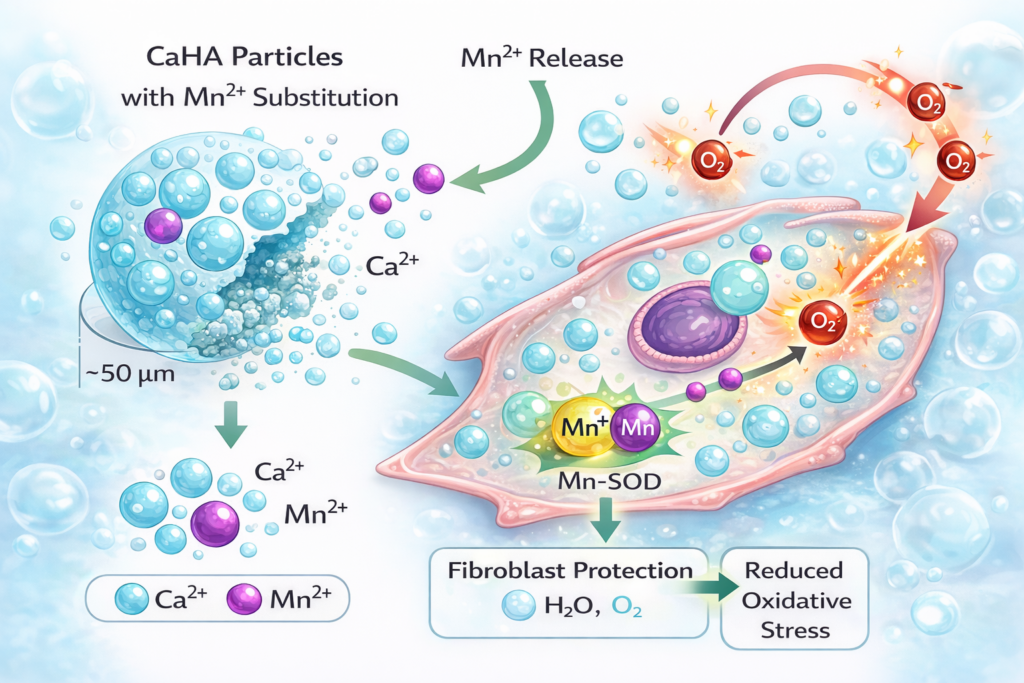
Fibroblast Protection via Substituted Manganese Ions: The material’s soft blue hue is achieved through carefully engineered incorporation of manganese (Mn) into its natural crystal lattice (0.3% w/w). Manganese ions gently replace calcium (Ca²⁺) sites, subtly altering the way light interacts with the structure. This delicate transformation gives rise to a calm, naturally inspired blue tone — a balance of science and nature. Beyond its soothing color, manganese plays an important role in fibroblast protection. It acts as a cofactor for Manganese Superoxide Dismutase (MnSOD) — a vital mitochondrial antioxidant enzyme that neutralizes reactive oxygen species (ROS) within skin cells. By supporting fibroblast resilience and defending against oxidative stress, manganese helps maintain the skin’s natural vitality, firmness, and youthful radiance
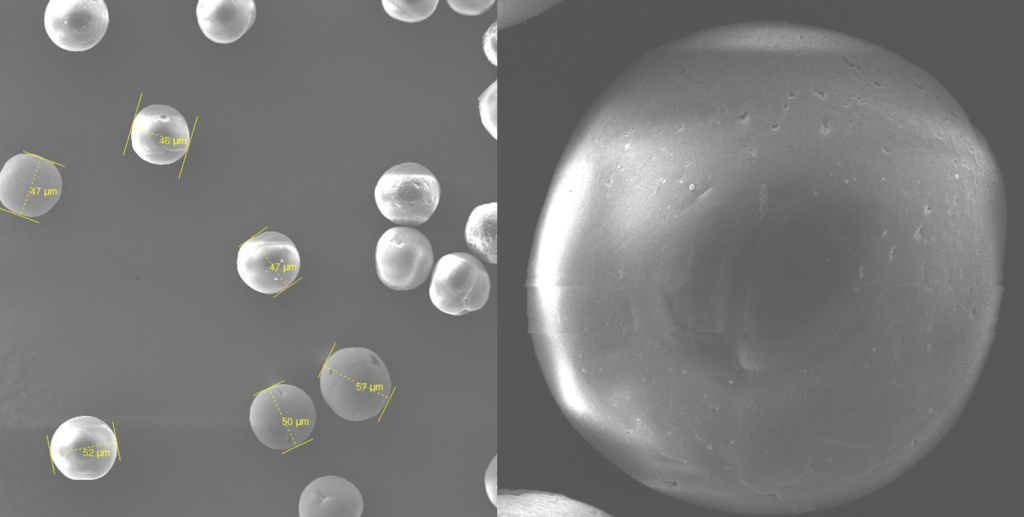
Disruptive Particle Size Technology: Xelestal+ represents a paradigm shift in CaHA dermal filler technology by incorporating smooth-surfaced, high-density particles in the 48–63 µm range, whereas all currently marketed CaHA fillers worldwide utilize smaller particles ranging from 25–45 µm. Meridian has developed a proprietary delivery technology that facilitates precise and efficient placement of these particles at the target site. The particles exhibit a narrow size distribution, with a mean diameter of approximately 50 µm, promoting a consistent and homogeneous host tissue response following injection. Importantly, the controlled particle size distribution, smooth surface morphology, and optimized injectability are designed to minimize particle aggregation and uneven tissue integration, thereby mitigating the risk of nodule formation despite the larger particle size range.
Subtle in formulation. Intentional in mechanism. Precise in outcome.
Larger-diameter particles are associated with the formation of thicker and denser collagen encapsulation, contributing to enhanced structural reinforcement within the treated tissue. This pattern of collagen deposition is particularly advantageous for restoring durable volume and firmness in areas characterized by diminished dermal support. As a result, the following benefits may be observed:
• Stronger Volume Restoration: Due to the larger particle size, the filler may provide more robust support to the skin, with greater lift and firmness.
• Longer Lasting: The larger particles may be more resistant to resorption, leading to a potentially longer duration of effect compared to smaller particle-based fillers.
• Tissue Response: The larger particle size could influence how the body reacts to the filler. Larger particles might induce a different type of collagen production or tissue remodeling, potentially leading to longer-term structural benefits.
• Reduced Risk of Migration: Larger particles may help to reduce the risk of migration or shifting once injected into the tissue, as they are less likely to spread compared to smaller particles.
• Injection Experience: Larger particles could slightly alter the injection experience, making it slightly more challenging for practitioners to inject compared to smaller particle-based fillers, though this depends on the carrier gel’s viscosity and consistency.